Professors Laura Donohue and Todd Huntley moderated panels at the American Bar Association’s 35th Annual Review of the Field of national security law CLE conference.
Professor Donohue’s panel was on the rise of autonomous vehicles and Professor Huntley’s panel was on technology, over the horizon operations, and the power to make war
Read more about the panel below and learn more about the conference here.
Panel: The Rise of Autonomous Vehicles
Unmanned aerial vehicles (UAVs) present threats, opportunities, and myriad legal questions.
The weaponization of commercial and small drones, threat of swarms, and persistent challenges in detection and mitigation create vulnerabilities. Paired with biometric and tracking capabilities, outdated statutory provisions have left the country unprepared. Low cost and wide availability allow for a range of actors, from terrorists and criminals to foreign intelligence services, to acquire and modify UAVs for malicious purposes. Drone swarms involving dozens or even hundreds of UAVs can overwhelm conventional air defense systems. Radar systems may struggle to distinguish small drones from birds, while optical and acoustic systems are hampered by low visibility, ambient noise, or line-of-sight limitations. Coordinated drone activity can disrupt operations at airports and military facilities, force evacuations, and cause widespread panic. They also can undermine military operations, as we have already seen in the context of the Russia-Ukraine war. Unmanned aerial systems (UAS)
simultaneously offer opportunities to increase efficiency, reduce costs and risks, and provide novel capabilities. From entertainment, construction, and first responder services, to agriculture, mapping, and the delivery of goods, many sectors stand to benefit. Unmanned Underwater vehicles (UUVs) similarly create new opportunities across military, commercial and scientific arenas by offering safer, more efficient, and longer-duration underwater operations. Large-displacement UUVs (LDUUVs), including extra-large versions (XLUUVs) can operate without a human crew in hazardous or remote environments, altering the economics and capabilities of undersea missions. The drone market is projected to grow significantly, creating new business models, jobs, and applications. The panel will explore how to think about UAVs/UUVs – and counter-strategies in today’s environment and how
their use fits into the law of armed conflict. The panel will further address the Court’s First and
Fourth Amendment doctrines along with other legal questions central to UAV/UUV technologies.
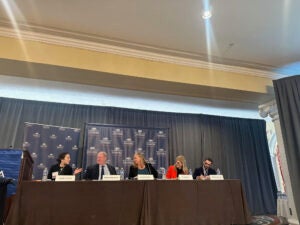
Moderator:
Laura K. Donohue
Scott K. Ginsburg Professor of Law and National Security
Director, Center on National Security and the Law and
Director, Center on Privacy and Technology
Georgetown Law
Panelists:
Jennifer C. Daskal
Partner, Venable LLP
Lisa Ellman
Chair of the Uncrewed Aircraft Systems (UAS) practice, Hogan Lovells
Co-founder and Executive Director, Commercial Drone Alliance
Philip Lockwood
Managing Director and SVP of Strategy, STARK International
RADM (Retd.) Mark Montgomery
Senior Director, Center on Cyber and Technology Innovation
and Senior Fellow, Foundation for Defense of Democracies
Panel: Technology, Over the Horizon Operations, and the Power to Make War
The devastating U.S. air strikes against Iran’s nuclear sites during the so-called 12-Day War were just one among a growing list of unilateral presidential decisions to use military force in pursuit of national interests. Since the passage of the War Powers Resolution in 1973, over President Nixon’s veto, two trends have run in parallel that have steadily reduced Congress’ Article I prerogative under the “declare war clause”: The executive branch’s progressively narrow interpretation of war and hostilities in the constitutional and statutory sense, respectively; and technological advances, such as the increasing reliance on drones, that have enabled increasingly substantial and effective stand-off combat operations. These tech-driven, no-boots-on the-ground operations have raised substantial legal questions as to the respective division of Article I (congressional) and Article II (presidential) authority to initiate and
authorize conflict, as well as related questions as to the scope of “self-defense.” This panel will discuss the state of war powers in the age of new and emerging technology, its impact on the law, and the role of lawyers in assessing the outer bounds of permissible exercises of lethal force.
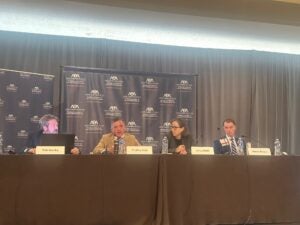
Moderator:
Todd C. Huntley
Director, National Security Law Program
Georgetown University Law Center
Panelists:
Geoffrey S. Corn
George R. Killam Jr. Chair of Criminal Law and Director Of the Center for Military Law and Policy Texas Tech University School of Law
Ashley S. Deeks
Vice Dean, University of Virginia School of Law and Senior Fellow, Miller Center
Charles ‘Cully’ Stimson
Deputy Director, Edwin Meese III Center for Legal and Judicial Studies
Manager of the National Security Law Program and Senior Legal Fellow Heritage Foundation